Field Service
Why Small Businesses Need Field Service Management Software
Manage field teams, customer jobs, schedules, payments, and daily operations without relying on spreadsheets and WhatsApp.
By Bonx team · · Updated · 7 min read
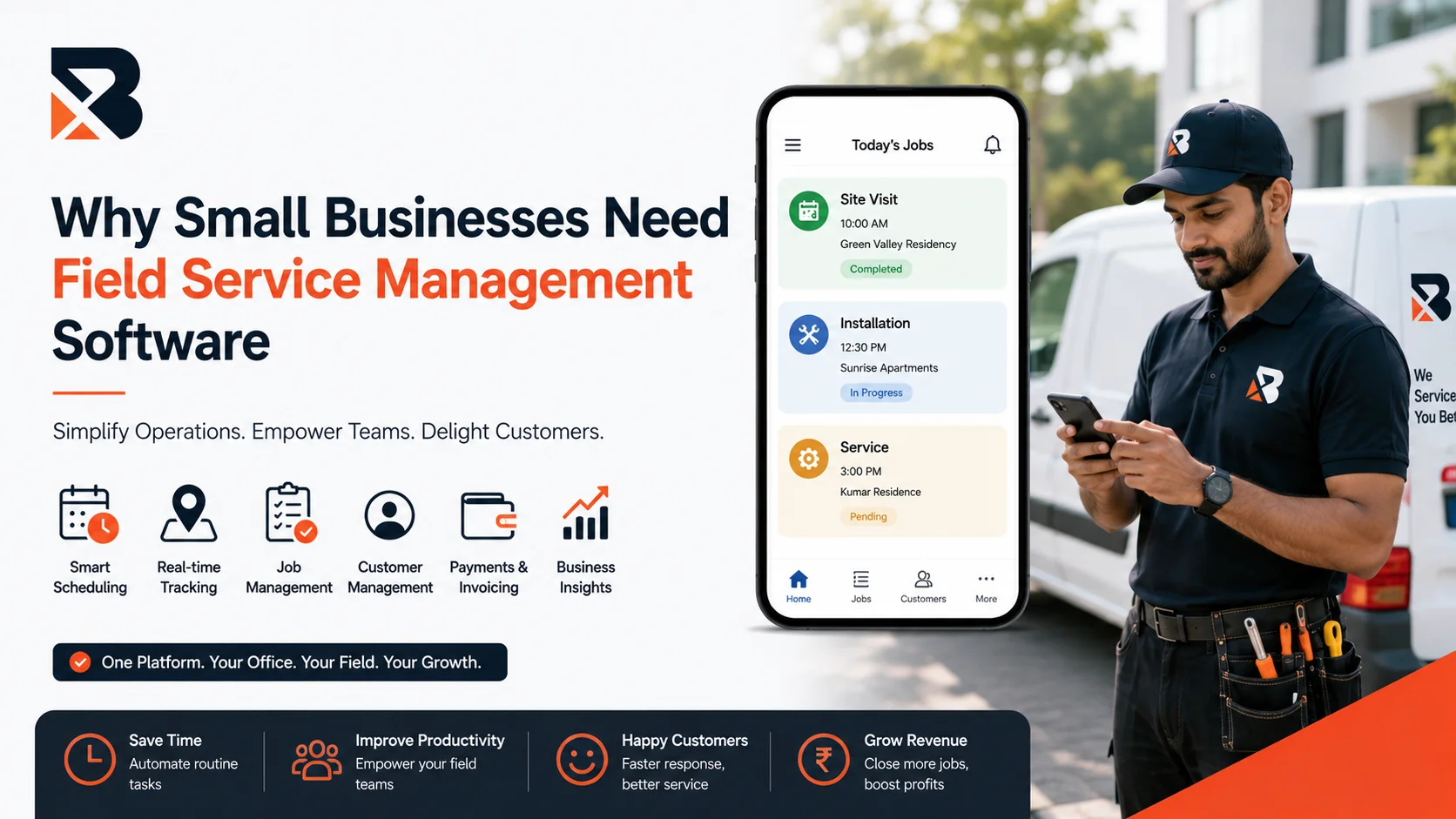
Running a small service or installation business can look simple from the outside.
You have customers, employees, projects, and payments. But as the number of jobs increases, managing everything becomes much harder.
A customer calls for a service. Another customer needs a site visit. A technician is already working at another location. A quotation needs to be sent. Someone needs to follow up on a pending payment.
Suddenly, the business owner is managing dozens of small tasks every day.
Many small businesses handle this using WhatsApp, phone calls, notebooks, and spreadsheets. These tools may work when the business is small, but they become difficult to manage as the number of customers and field employees grows.
This is where Field Service Management Software can help.
1. Keep Field Work Organised
Field teams spend most of their working day outside the office.
They may be visiting customers, inspecting sites, taking measurements, delivering materials, installing products, or resolving service complaints.
Without a centralised system, information can quickly become scattered.
One employee may receive instructions through WhatsApp. Another may receive a phone call. The office may have the customer information in an Excel file.
A field service management system brings these activities into a structured workflow.
Businesses can organise:
- Customer jobs
- Site visits
- Field tasks
- Installation schedules
- Service requests
- Team assignments
- Job status
- Customer information
This gives the office and field teams a common view of what needs to be done.
2. Manage More Jobs Without Immediately Hiring More People
Growth doesn't always mean hiring more employees.
Sometimes the problem is that existing employees spend too much time on administrative work.
For example, a field employee may spend time calling the office to ask:
"Which customer should I visit next?"
"What was the customer's requirement?"
"Did we already send the quotation?"
"Has the customer made the advance payment?"
A centralised field service management system can reduce this unnecessary communication.
When employees have access to the right information, they can spend more time doing actual field work.
Better organisation can help a small team handle more customers without immediately increasing its headcount.
Read also: How to Improve Customer Experience
3. Reduce Missed Appointments and Delayed Jobs
Scheduling becomes difficult when multiple employees are visiting different customers every day.
A job can easily be forgotten or assigned incorrectly when schedules are maintained manually.
Field service software can help businesses organise:
- Upcoming site visits
- Installation dates
- Service appointments
- Assigned employees
- Pending jobs
- Completed jobs
Instead of asking employees to remember everything, the system provides a clear view of upcoming work.
This is particularly useful for businesses handling multiple installations or service calls at different locations.
4. Give Customers Better Service
Customers don't see your internal problems.
They only see the experience they receive.
If a technician arrives late, the customer doesn't know that the employee received the wrong information.
If a service request is forgotten, the customer doesn't care that the complaint was buried inside a WhatsApp conversation.
From the customer's perspective, the business simply failed to respond.
Field service management software helps create a more consistent customer experience by making it easier to track:
- Customer requests
- Job status
- Appointment schedules
- Site visit information
- Installation progress
- Service complaints
- Follow-ups
Better internal organisation often results in better customer communication.
5. Connect Office Teams With Field Teams
One of the biggest challenges for service businesses is the gap between the office and the field.
The office manages customers, sales, quotations, payments, and planning.
Field employees handle site visits, installations, service work, and customer interactions.
If these teams don't share information properly, problems appear.
For example:
Office: Customer needs installation tomorrow.
Field: Employee doesn't know the latest requirement.
Or:
Field: Customer requested additional work.
Office: Sales team doesn't know about the request.
A connected system helps information move between teams without depending entirely on calls and messages.
6. Track Payments and Outstanding Amounts
Field employees are sometimes involved in collecting payments, especially in installation and service businesses.
When payment information is handled manually, it becomes difficult to know:
- How much the customer has paid
- How much is outstanding
- When the payment was collected
- Which employee collected it
- Which job the payment belongs to
Connecting payments with customer and job information provides better visibility.
It also reduces the chances of payment information being lost between the field and office.
7. Get Better Visibility Into Your Business
As a business owner, you need more than a list of customers.
You need to understand what is happening across the business.
Useful information includes:
- Number of active jobs
- Completed installations
- Pending site visits
- Open service complaints
- Pending payments
- Team workload
- Sales pipeline
- Project progress
This information helps business owners make decisions based on actual business activity instead of assumptions.
8. Reduce Dependence on WhatsApp and Spreadsheets
WhatsApp is useful for communication.
Spreadsheets are useful for certain types of data.
But neither was designed to manage an entire field-service operation.
As the business grows, information can become scattered across:
- WhatsApp groups
- Personal chats
- Excel files
- Notebooks
- Phone calls
- Emails
The problem isn't that these tools are bad.
The problem is that important business information becomes difficult to find and connect.
Field service management software provides a dedicated system for managing the operational workflow.
Who Can Benefit From Field Service Management Software?
Field service software isn't limited to traditional repair companies.
It can be useful for many installation and service-led businesses, including:
- Solar installation companies
- Electrical contractors
- EV charging businesses
- Interior and renovation companies
- Aluminium and window businesses
- Fabrication companies
- HVAC businesses
- Security system installers
- Home improvement companies
- Equipment installation businesses
If your employees regularly travel to customer locations to inspect, install, deliver, repair, or service something, field service management software may be useful for your business.
When Should a Small Business Start Using Field Service Software?
You don't need hundreds of employees before considering field service software.
In fact, implementing a system early can make growth easier.
You may need field service software when:
- You are managing multiple field employees.
- Customers are increasing quickly.
- Jobs are being missed or delayed.
- Employees need information from the office frequently.
- You are using multiple spreadsheets.
- Customer information is scattered across WhatsApp.
- You struggle to track site visits and installations.
- Payment collection is difficult to monitor.
- You don't have a clear view of ongoing jobs.
These are signs that your business is starting to outgrow informal processes.
#FinalThoughts
Small businesses don't need complicated systems.
They need systems that remove unnecessary complexity.
Field Service Management Software can help connect customers, office teams, field employees, jobs, site visits, installations, payments, and service operations in one organised workflow.
The goal isn't simply to replace WhatsApp or spreadsheets.
The goal is to build a business that can handle more customers without creating more confusion.
When your field team knows what to do, your office knows what's happening, and your customers receive timely service, the entire business becomes easier to manage.
The right software doesn't replace your team. It helps your team work better.