EV Charging
How to Choose the Right EV Charging Station Partner
Understand the key factors to consider when selecting an EV charging station partner for installation, support, reliability, and long-term operations.
By Bonx team · · Updated · 5 min read
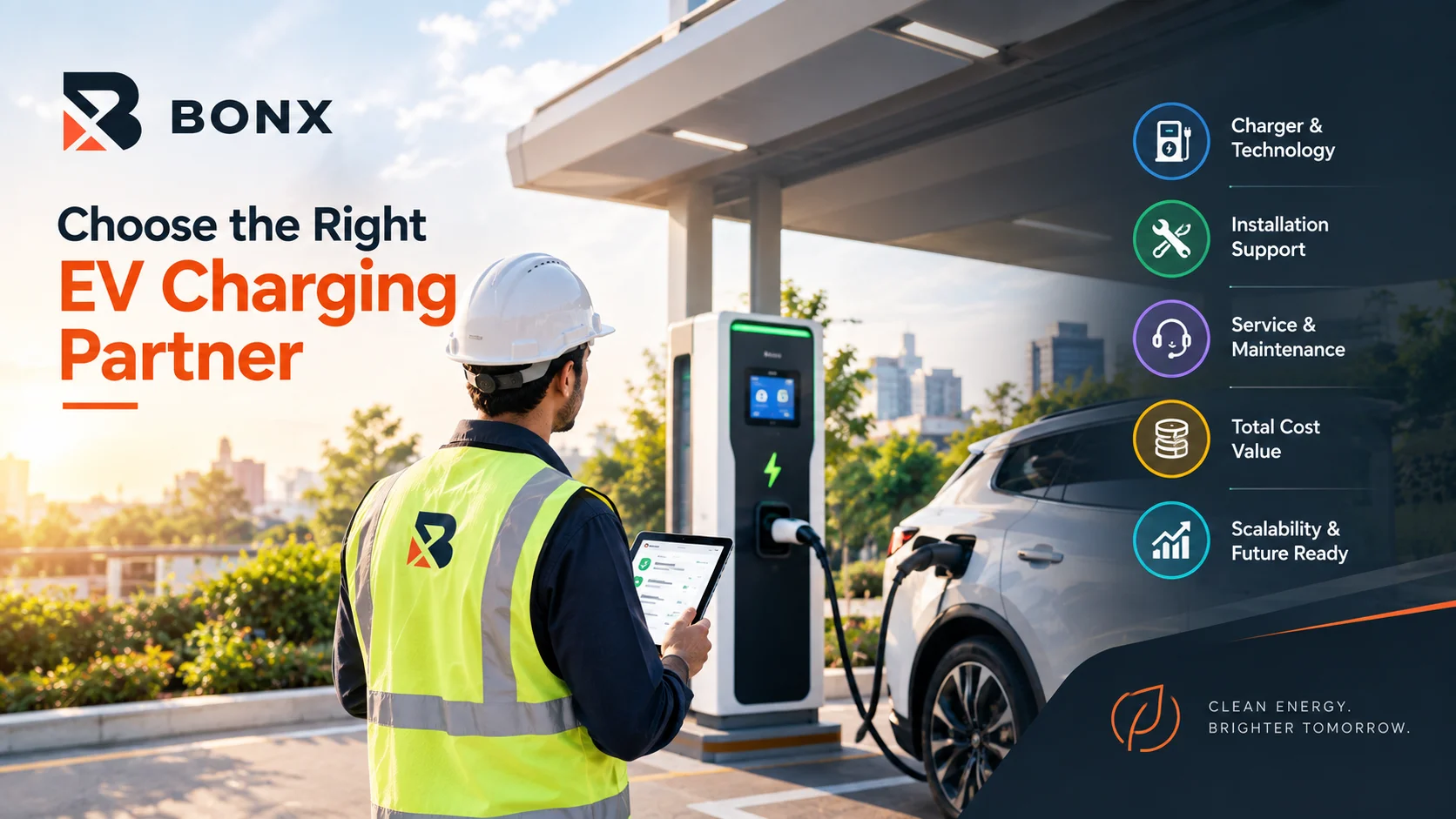
Setting up an EV charging station is not about buying a charger.
The partner you choose can affect installation quality, equipment reliability, customer experience, maintenance, and your charging business's long-term operation.
Whether you are installing a charger for your own business, setting up charging infrastructure for customers, or building a larger EV charging network, choosing the right partner requires looking beyond the initial price.
A good EV charging station partner should be able to support you through the complete journey:
Requirement → Equipment → Installation → Commissioning → Support → Maintenance
Here are the key factors to consider before deciding.
1. Understand the Charger and Technology
Start by understanding exactly what you are buying.
EV charging requirements can vary depending on the vehicle, location, expected usage, and type of charging business.
Before selecting a partner, consider:
- AC or DC charging requirements
- Charging capacity
- Connector compatibility
- Number of charging points
- Charging speed
- Electrical requirements
- Communication capabilities
- Remote monitoring
- Software compatibility
- Future upgrade options
The right solution depends on your specific use case.
A charger selected for a residential installation may have very different requirements from one intended for a commercial parking facility, fleet operation, highway location, or public charging station.
2. Check the Installation Support
Buying equipment is only one part of the project.
Proper installation is important for safety, reliability, and long-term performance.
Ask the potential partner what installation support they provide.
This may include:
- Site assessment
- Electrical inspection
- Load assessment
- Installation planning
- Cabling
- Mounting
- Electrical protection
- Testing
- Commissioning
- Installation documentation
A partner that understands both the equipment and the site requirements can make the installation process more structured.
Before starting the project, clarify who is responsible for each part of the installation.
3. Evaluate Service and Maintenance Support
An EV charging station is an operational asset.
If it stops working, the problem can affect customers, revenue, and the reputation of the business.
Ask questions such as:
- Who provides technical support?
- How can service requests be raised?
- What is the expected response process?
- Are spare parts available?
- Is preventive maintenance available?
- Who handles software-related issues?
- What happens after the warranty period?
A low purchase price may not mean a low total cost if service problems are difficult or expensive to resolve.
Look at the complete support model rather than only the initial equipment price.
4. Compare Total Cost, Not Just Purchase Price
Price is important, but the cheapest quotation is not necessarily the lowest-cost solution over the entire project lifecycle.
Consider the complete cost, including:
- Charger cost
- Installation
- Electrical work
- Civil work
- Cabling
- Networking
- Software or platform charges
- Maintenance
- Spare parts
- Payment or transaction charges
- Warranty-related costs
- Future upgrades
For example, two chargers may have similar purchase prices but very different installation or maintenance requirements.
A useful comparison is:
Total Cost = Equipment + Installation + Operations + Maintenance + Other Long-Term Costs
This gives you a clearer picture of the investment.
5. Consider Scalability and Long-Term Compatibility
Your first charging station may not be your last.
If your business grows, you may want to add more locations, more charging points, or different types of chargers.
Before selecting a partner, consider whether the solution can support future expansion.
Ask:
- Can additional chargers be added easily?
- Can multiple locations be managed together?
- Is remote monitoring available?
- Can the system support more users?
- Can charging data be accessed centrally?
- Can the technology integrate with future systems?
- Is the partner capable of supporting expansion?
Choosing a solution with future growth in mind can reduce the need to replace systems later.
What Should You Ask an EV Charging Partner Before Signing?
Before making a decision, create a simple evaluation checklist.
### Equipment
- What charger models are available?
- What charging capacities are supported?
- Which connectors are supported?
- What certifications and safety features apply?
### Installation
- Is site assessment included?
- Who handles electrical work?
- Who handles civil work?
- Is commissioning included?
### Software
- Is remote monitoring available?
- Can charging activity be tracked?
- Is there an operator dashboard?
- Can multiple locations be managed?
### Service
- How are service requests handled?
- What warranty is provided?
- Are spare parts available?
- What maintenance options are available?
### Commercials
- What is the complete project cost?
- Are there recurring software charges?
- Are installation charges separate?
- What costs may occur later?
A written comparison can make it easier to identify differences between potential partners.
## Don't Ignore the Operational Side of an EV Charging Business
Choosing the equipment partner is important, but operating the charging business also requires an organised workflow.
Once a customer or location is acquired, the business may need to manage:
Lead → Site Visit → Quotation → Order → Installation → Payment → Service
As the number of installations grows, keeping this information across spreadsheets, messages, and separate records can become difficult.
A connected business management platform can help keep customer, sales, installation, payment, and service information organised.
BONX is designed for installation-led businesses and can help manage workflows such as leads, site visits, quotations, operations, installation, payments, complaints, and after-sales service.
For an EV charging business, this can provide a connected workflow from the initial customer enquiry through installation and ongoing service.